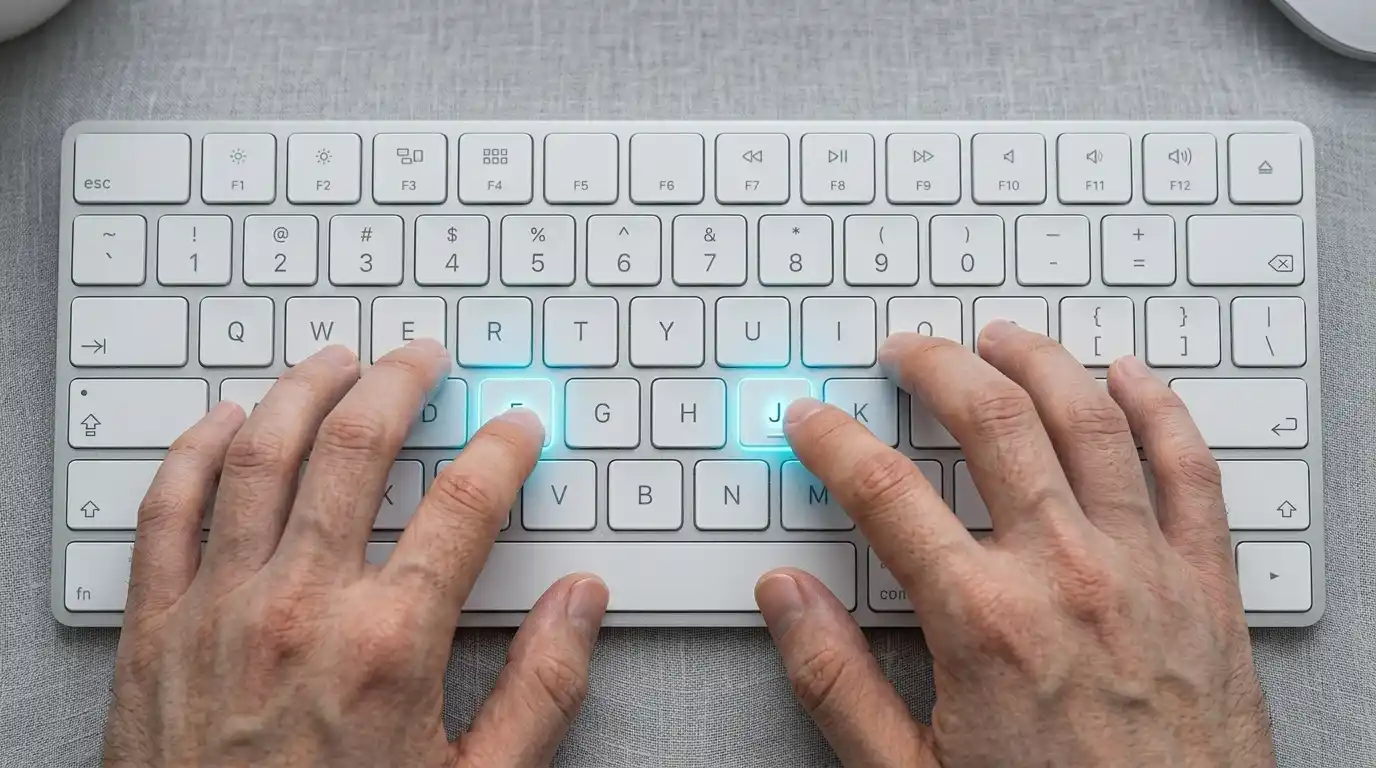
You know the feeling. You are typing along, things are going well, and suddenly you lose your place. You immediately look down at your hands to find the right key.
Looking at the keyboard is the number one habit keeping you from reaching 100 WPM. It breaks your focus and instantly kills your typing rhythm.
Let's talk about why your brain forces you to look down, and how you can train your muscle memory to type completely blind.
Why Your Brain Wants You to Look
Your brain is wired to solve problems quickly. When your fingers forget the location of a key like "P" or "C," your brain triggers an automatic reflex to use your eyes to find it.
But here is the catch: typing is a physical skill, not a visual one. According to studies on visuomotor skills, typing relies heavily on the motor cortex and cerebellum. It does not rely on your visual system.
When you look down, you interrupt that mind-muscle connection. To unlock true speed, you have to force your brain to rely entirely on the sense of touch.
The Magic of the "F" and "J" Bumps
You do not need to look at your keyboard to find your starting position. Run your index fingers over the "F" and "J" keys. You will feel a tiny plastic bump or ridge on each.
These bumps are your anchors. Whenever you lose your place, do not look down. Simply slide your index fingers lightly across the middle row until you feel those bumps. This resets your hands perfectly without breaking your screen focus.
How to Build Bulletproof Muscle Memory:
Muscle memory is not built overnight. It is formed through consistent, highly accurate repetition. Here's how to train it correctly:
1. Hide your hands
If you can't resist looking down, cover the keys. You can buy blank keyboard stickers or put a light towel over your hands while practicing. This forces your brain to map the keys by feeling.
2. Take frequent breaks
Science shows your brain rehearses and solidifies motor skills faster during short rest periods. Do not type for two hours straight. Take a short break every twenty minutes to let your muscle memory settle.
3. Stop practicing your mistakes
Every time you hit the wrong key, your body remembers it. Muscle memory does not care if the keystroke was right or wrong; it only remembers repetition. Slow down and focus entirely on hitting the correct letter.
The Bottom Line
Breaking the habit of looking down will feel frustrating for the first few days. Your WPM will drop, but that is a completely normal part of rewriting your bad habits.
Ready to test your blind typing skills? Open up a practice session on TypingCraft. Keep your eyes firmly on the screen, find the "F" and "J" bumps, and see what your accuracy looks like when you finally trust your fingers.